Moondogs: Music & Halos

Kasey Dirga • November 11, 2025

Moondogs:

The Blind Viking of Sixth Avenue & the Light Beside the Moon


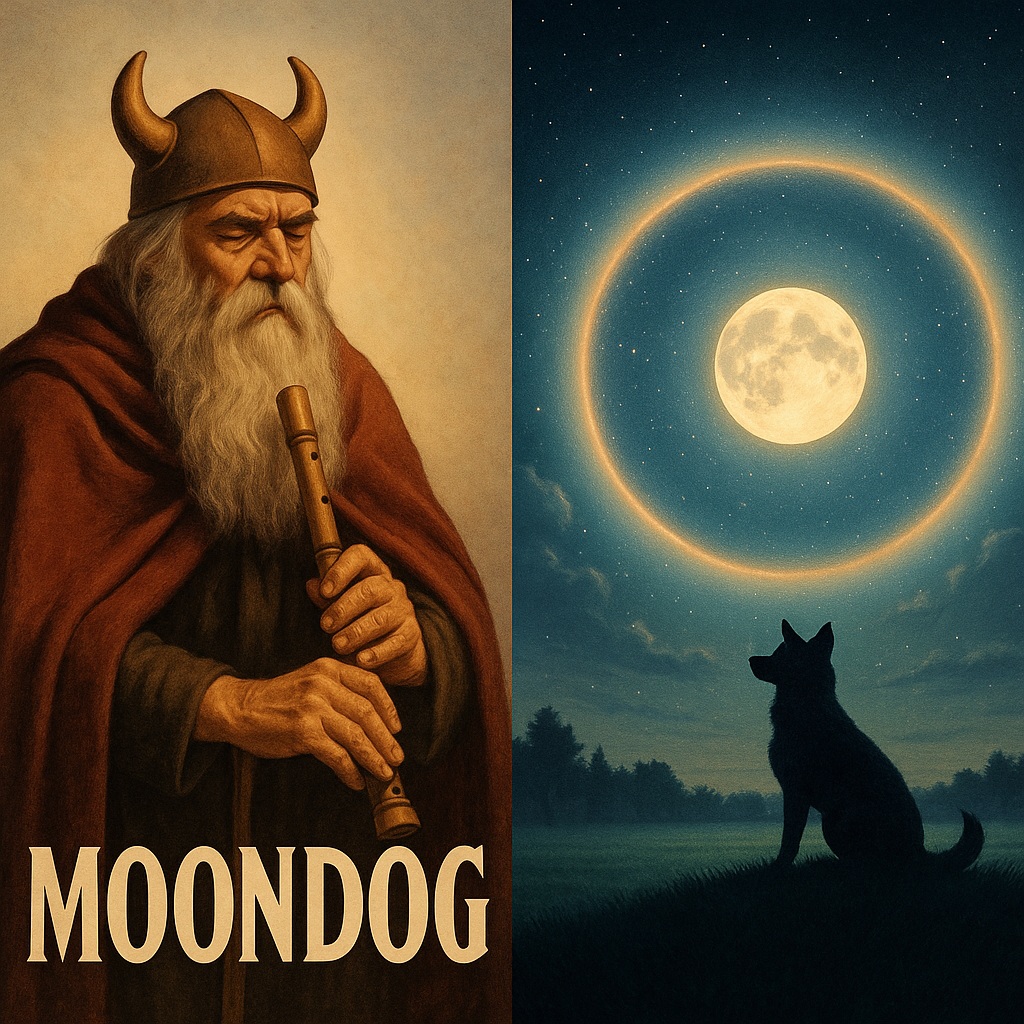
On a cold New York night in the 1950s, a man in a horned helmet stood on a Manhattan corner, selling sheet music and playing his own inventions. He was blind, tall, wrapped in furs, and known simply as Moondog. To some, he looked like a Norse god who had wandered into modernity; to others, he was a prophet of sound. In truth, he was Louis Thomas Hardin Jr. — a visionary composer whose life and music refracted the light of genius through the crystal edges of limitation.


The Man Who Heard in Patterns


Born in Kansas in 1916, Hardin lost his sight at sixteen after a blasting cap accident. Instead of dimming his world, blindness sharpened his ear. He learned music by touch and intuition, hearing rhythm in the rumble of trains, in footsteps, and in the chaos of city streets. When he moved to New York in the 1940s, he became a living legend — part street performer, part philosopher, part composer.


He called his rhythmic structure "snaketime", a pulse that moved with the freedom of a serpent rather than the strictness of a metronome. The visionary composer Moondog (born Louis Thomas Hardin) didn’t just compose his music—he also invented a remarkable array of instruments to realize it. Among his creations were the small triangular harp called the “oo,” a larger variant dubbed the “ooo-ya-tsu,” the triangular string instrument “hüs” (from the Norwegian hus, meaning “house”), and perhaps most famously the percussion instrument “trimba” – essentially a triangular drum structure combining cymbal and drums, which offered him unique rhythmic textures. Check them out here 🪉


The Name and the Myth


Moondog took his name from a beloved pet — a dog that howled at the moon back on his family’s farm. That image of loyal wildness stuck with him, and the name became his signature. He was both dog and moon: earthbound yet celestial, feral yet refined.

In a poetic twist, nature offers its own version of a "moondog." In atmospheric science, a moon dog is a pale halo or glowing patch of light that appears beside the moon, formed when moonlight bends through hexagonal ice crystals high in cirrus clouds. Moon dogs shimmer faintly, rare and spectral, their beauty often overlooked. They’re the night’s quiet echo of the more familiar sun dogs, those fiery halos that accompany the Sun.


Like the phenomenon, Moondog the man refracted light through what seemed like cold, invisible boundaries — blindness, loneliness, poverty — and turned it into radiance. Where others saw darkness, he created halos.


Legacy: The Halo That Never Fades


Throughout the 1950s and 60s, New Yorkers came to know him as the “Viking of Sixth Avenue.” He was a fixture of the streetscape, standing in his regal attire as taxis roared by, composing in his mind and selling records that would later inspire entire musical movements. In 1954, he even won a lawsuit against a radio DJ who had tried to steal his name — proof that even in a world built to overlook him, his identity could not be stolen.


In his later years, Moondog moved to Germany, where he continued composing until his death in 1999. His works — intricate canons, serene symphonies, and jazz-inflected miniatures — remain unlike anything else. They are pure Moondog: mathematical, mystical, deeply human.


The Lesson of the Moon Dogs


When you look up on a cold winter night and see two ghostly halos flanking the Moon — those are moon dogs, reflections of lunar light across frozen prisms in the sky. They’re a reminder that beauty often hides in diffraction, that brilliance comes from bending light, not competing with it.


So too was Moondog. He did not fight the limits of his life — he transformed them into an art form. He was the rare moon dog of humanity: a glimmer beside the Moon itself, proof that the periphery can be just as luminous as the center. His music remains a testament to defiant creation — to the howl in every heart that refuses silence. He showed us that light, no matter how faint, can always find its way through the frozen air.


On November 11, 2025—the one-year anniversary of Doggy K Care’s founding—I wanted to honor two guiding lights: a man whose creativity I deeply admire, and the moon, my celestial companion who joins me on my early morning walks. I’m endlessly grateful for the animals who have found their way into my life, for the shifting phases of the Moon that I watch with reverence, and for visionaries like Moondog, who remind us how to stay wildly weird, fiercely authentic, feral while refined, and beautifully balanced between the earth and the stars. 🌕🐺


LISTEN TO MOONDOG'S FULL ALBUM HERE:   

MOONDOG 1969

By Kasey Dirga November 25, 2025
Discover how your dog shows you love in quiet, meaningful ways — from soft eye contact to toy sharing and simple closeness by Doggy K Care in Paducah KY.
By Kasey & Piper Dirga November 4, 2025
🛸 The Ancient Cosmic Mystery of the Word “Dog” 🐾 A Word Lover’s Preface I’ve always been a lover of words — their shapes, their sounds, and the secret histories tucked inside them. Since childhood, I’ve read the dictionary like a novel, savoring every unexpected root and hidden meaning. My paternal grandmother gifted me a very old beautiful dictionary complete with color drawings and chapters of information like an encyclopedia. She lit a fire in me to be curious about etymology and the organization of words. There’s something delicious about tracing a word back through time — like following a trail of ancient pawprints across history. Etymology, to me, is archaeology of sound — unearthing how humans have tried to capture their experiences, their gods, their pets, and their hearts through language. Some words are straightforward. Others are puzzles. And then there’s dog — a word so familiar, yet so mysterious, it might just have fallen from the stars. A Word Without a Pedigree If you think you know where dog came from… think again. Linguists, historians, and even the occasional ancient-alien enthusiast agree on one thing: nobody really knows. dog /dôɡ, dŏɡ/ noun A domesticated carnivorous mammal (Canis familiaris), bred in many varieties, long regarded as humankind’s loyal companion and guardian. (Astronomy) A bright spot appearing on one side of the Sun or Moon, caused by the refraction of light through ice crystals in the atmosphere; also called a sun dog or moon dog. (Informal, often derogatory) A contemptible or untrustworthy man; a scoundrel . The word docga (pronounced roughly DOH-jah) is Old English, and it’s the earliest known ancestor of our modern word dog. Here’s the fascinating part: Docga was a rare, late Old English word, not the usual term for a canine. The common Old English word for a dog at that time was hund, which is still seen in German “Hund” and Dutch “hond.” Scholars think docga might have originally meant a powerful breed of dog, maybe something like a mastiff or fighting dog. Its origin is unknown — it doesn’t have any clear relatives in other Germanic languages. That makes it what linguists call a “mystery root.” The word dog eventually replaced the Old English hund — by the 16th century, dog had completely taken over and even spread to other languages (French dogue, German Dogge, Danish dogge). How this scrappy little syllable muscled out centuries of Indo-European lineage remains an open question. And for bonus mystery points, even Spanish’s perro and the Slavic pas/pies have unknown origins. In other words, no one knows where anyone’s dogs came from — linguistically speaking. It’s one of those delightful linguistic puzzles that feels a bit magical — as if dog just appeared out of nowhere, wagging its tail into modern language. From Best Friend to Scoundrel By the 1200s, dog had already gone metaphorical — used as an insult for “a mean, worthless fellow, currish, sneaking scoundrel.” (And haven’t we all known a few of those?) By the 1600s, it evolved again into the playful “rake” or “gallant,” and by the 1950s, slang had promoted it to “sexually aggressive man.” These are the kinds of dogs you steer clear of — don’t fall in love with them and definitely don’t marry and have their children. The world does not need more of these weak kerov i (that’s plural for ker, which means ‘dog’ in Slavic slang ). The Dogon, the Dragon, and the Deep Unknown Now the story tilts skyward. Across the sands of Mali, the Dogon people have fascinated scholars for generations. Their ancient cosmology centers on Sirius — the brightest star in Earth’s night sky, also known as the Dog Star . Long before telescopes, Dogon traditions described invisible companion stars orbiting Sirius. Modern astronomers would later confirm that Sirius is indeed a binary system — Sirius A and Sirius B — and possibly even a trinary one. How the Dogon knew this remains one of anthropology’s great riddles. Some credit divine intuition; others whisper of ancient contact with beings from the stars — the luminous Nommo , who descended to teach humankind language, agriculture, and cosmic order. And then there’s dragon — from Greek drakōn, Latin draco, meaning serpent or great watcher. Entirely different roots, yes, but the resonance between dog, Dogon, and dragon hums in the same register: guttural, primal, ancient. Could early tongues have sensed something sacred in that sound? Something guarding the threshold between earth and sky? The Star That Started It All To the ancient Egyptians, Sirius was no ordinary star. They called it Sopdet (Greek Sothis), and its rising each year heralded the flooding of the Nile — an event symbolizing rebirth, abundance, and divine guardianship. It was the celestial reminder that light always returns after darkness. It’s easy to see why cultures across time associated this radiant star with loyalty, vigilance, and guidance — the very traits we cherish in our dogs. The same light that guided the Nile may well have inspired humanity’s image of the dog as eternal companion — guardian of the threshold, keeper of the way home. So perhaps dog isn’t just a random bark of language that stuck. Perhaps it carries a faint echo of Sirius — a syllable of starlight that still glimmers in our speech. ✨ Cosmic Conclusion At Doggy K Care , we celebrate that mystery. Whether your best friend descends from mastiffs, mutts, or Sirius itself, we speak their language — ancient, cosmic, and full of love. And as for the scoundrel ker that may have come across your doorstep like a runaway varmint? Let them chase their own tails while we bask in the light of true loyalty — the kind that greets you at the door, wags at the stars, and reminds you daily that devotion, not deceit, is the highest form of intelligence. If your pup lifts their nose to the night sky, don’t be surprised. They might just be saying hello to their ancestors among the stars. Maybe 3iAtlas is going to make contact and be a spaceship full of cosmic doggies!
Show More